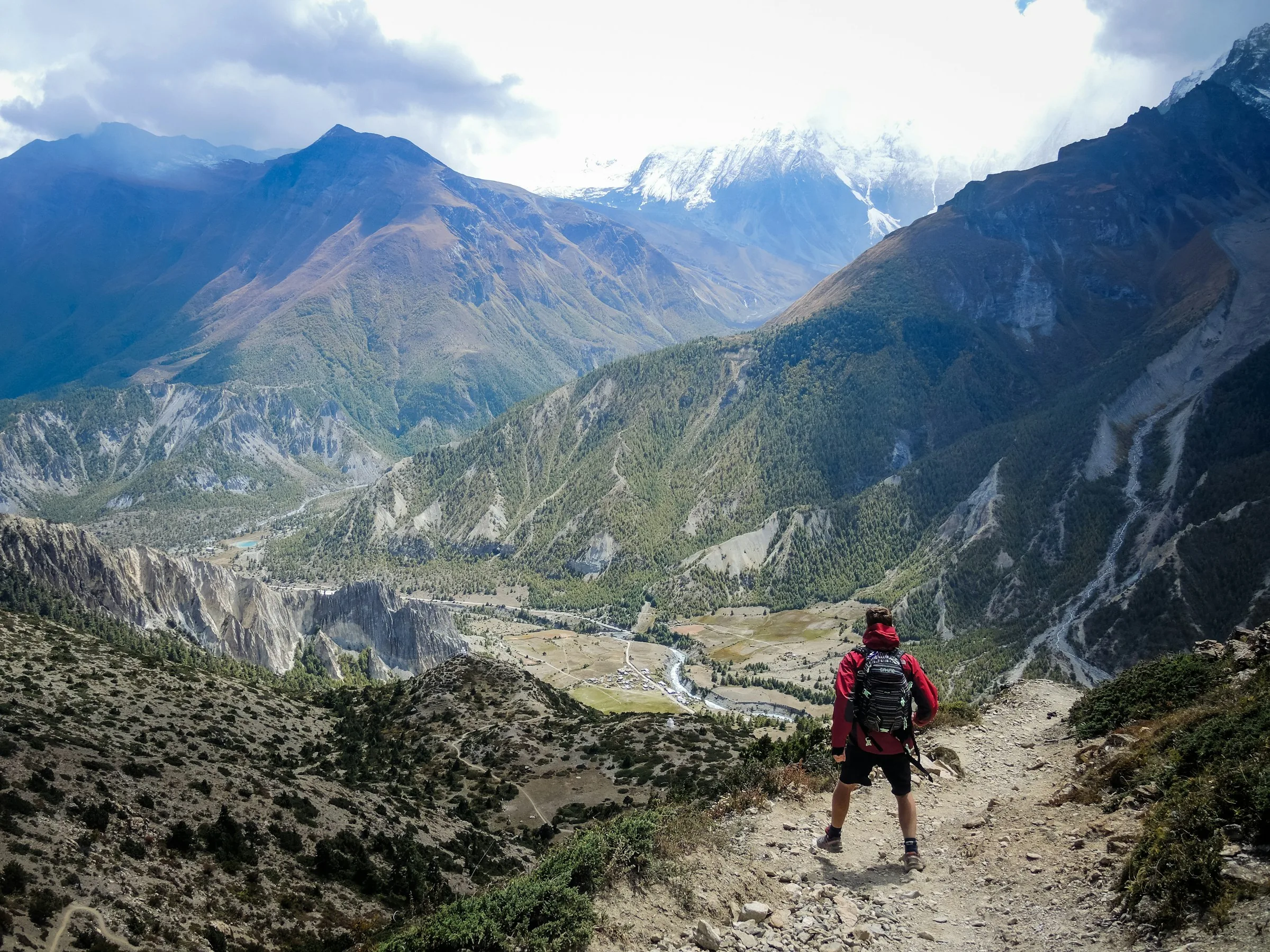
Independent trekking in Nepal is alive and well in 2026, despite a few years of headlines that suggested otherwise. This is the longer planning piece — what's legal where, what permits you actually need, what it costs end-to-end, who it's for, and how to plan the trip without paying an agency a thousand-dollar fee for paperwork you can do yourself. Where the detail gets dense, we link out to the deep-dive guides.
The 2023 rule, and what actually changed
In April 2023 the Nepal Tourism Board announced that all foreign trekkers must be accompanied by a licensed guide. The headline went around the world. The detail did not. The rule applied to TIMS-controlled trekking — and TIMS is a separate system run by NTB and the Trekking Agencies' Association of Nepal. It is not the conservation-permit system run by NTNC.
What that means in practice: ACAP (Annapurna), MCAP (Manaslu), GCAP (Gaurishankar) and most national park entry permits are unaffected. The conservation areas are still open to independent trekkers. The trailhead checkpoints do not ask for guides on the Annapurna routes; we cover the precise mechanics of that in the dedicated piece on the Annapurna question.
Where the rule does bite is the regions that were already restricted before 2023 — Manaslu, Tsum, Upper Mustang, Dolpo, Nar Phu, Kanchenjunga. Those needed an agency and a guide before, still need them now, and were never available for genuine solo trekking. The 2023 announcement didn't change that picture; it just added a layer of confusion to the regions where independent trekking was already fine.
Where you can go solo, where you can't
The map of Nepal trekking, from a permit-and-paperwork perspective:
| Region | Permits | Guide? |
|---|---|---|
Annapurna (ACAP) ABC, the Circuit, Mardi Himal, Poon Hill, Khopra. The default solo region. | ACAP only | Not required |
Langtang Open to independent trekkers. Closer to Kathmandu than the Annapurnas. | Langtang National Park entry | Not required |
Everest / Khumbu The grey area. Independent trekkers still go all the time; the rule is murkier than the Annapurnas. | Sagarmatha National Park + Khumbu Pasang Lhamu Rural Municipality | Technically required by 2023 rule, in practice rarely enforced for individuals |
Manaslu Conservation Area Restricted area. RAP only via a registered agency. | MCAP + Manaslu RAP | Required |
Tsum Valley Same restricted-area rules as Manaslu. | MCAP + Tsum RAP | Required |
Upper Mustang The expensive one. Tibetan plateau, walled city of Lo Manthang. | ACAP + Upper Mustang RAP (USD 500/10 days) | Required |
Gaurishankar (GCAP) Tamang Heritage Trail, lower Rolwaling. Quieter; less infrastructure than ACAP. | GCAP only (Rolwaling lower; restricted upper) | Not required for the GCAP routes |
Dolpo (Upper) Far west, very remote, harder logistics. | Shey-Phoksundo NP + Upper Dolpo RAP | Required |
Kanchenjunga Far east. Restricted both sides. | KCAP + Kanchenjunga RAP | Required |
The pattern: conservation areas are independent-friendly; restricted areas are not. If your shortlist is on the bottom half of that table, plan to book through an agency. If it's on the top half, you can do this yourself.
The permit landscape, simplified
Nepal's trekking paperwork comes in four families:
Conservation Area Permits
Solo-buyable- Examples
- ACAP, MCAP, GCAP, KCAP
- Issued by
- NTNC
- Cost
- NPR 3,000 (ACAP/MCAP/GCAP)
The "where you walk" entry fee for protected conservation areas. Buy online, in Kathmandu/Pokhara at the NTNC office, or through us.
National Park Entry Permits
Solo-buyable- Examples
- Sagarmatha, Langtang, Shey-Phoksundo
- Issued by
- Department of National Parks
- Cost
- NPR 3,000 typical
Different parks, same model. Bought at the entry checkpoint or in Kathmandu.
Restricted Area Permits (RAPs)
Agency only- Examples
- Manaslu, Tsum, Upper Mustang, Dolpo, Nar Phu, Kanchenjunga
- Issued by
- Department of Immigration
- Cost
- USD 30–500+ depending on region
Agency-only. Licensed guide required. The strict bit of Nepal trekking law.
TIMS card
Agency only- Examples
- —
- Issued by
- Nepal Tourism Board
- Cost
- NPR 2,000 (group), NPR 1,000 (SAARC)
Only for organised treks via a licensed guide. Not issued to independent trekkers any more.
We sell the conservation permits — ACAP, MCAP, GCAP — because those are the solo-buyable ones for the standard independent routes. National park entry permits are usually bought at the trailhead or in Kathmandu; RAPs you cannot buy yourself, you go through an agency. For the gory detail on the conservation-vs-restricted split, the Tsum Valley piece walks through the full structure.
What it actually costs to trek independently
The number that surprises most first-time trekkers is how cheap Nepal still is once you're on the trail. The expensive parts are the international flight and your gear; the in-country trek itself runs on a tight budget if you let it.
For a typical Annapurna-region independent trek:
- Permit: ACAP at NPR 3,000 plus our service fee — solo trekkers pay $44.28 all-in. The full breakdown is in the ACAP cost article.
- Lodge: $3–8 per night on the standard routes. Often free or near-free if you eat at the lodge.
- Food: $15–25 per day. Dal bhat is your friend; tea and snacks add up.
- Transport: $5–25 each way for the trailhead taxi or local bus from Pokhara/Kathmandu.
- Hot showers, charging, wifi: $1–5 each. Optional but pleasant.
- Gear: $0 if you have it; $50–200 if you rent or buy in Pokhara.
A 4-day Poon Hill trek runs about $130–200 all-in including the permit. A 9-day ABC trek runs $280–450. A 14-day Circuit runs $450–700. None of those numbers include the international flight, visa, or Kathmandu/Pokhara accommodation — those are separate.
By comparison, a guided ACAP trek bought through a Thamel agency typically runs $1,000–1,800 per person. The difference is mostly the agency margin and the guide's fee, both of which you can skip on the open routes.
Who is independent trekking actually for?
The Nepal trekking trail is not the Wilderness Of Doom that some travel writing suggests, but it is also not a casual stroll. A reasonable filter:
- Fitness: Can you walk uphill, with a 5–10 kg pack, for 5–6 hours, on consecutive days? Most reasonably-fit adults can.
- Altitude tolerance: Most people are fine up to 3,500–4,000 m if they ascend gradually and stay hydrated. Above that, individual variation matters and the only way to know is to go.
- Self-direction: Are you comfortable making decisions on the trail — when to stop, when to push on, when to bail? If yes, solo works. If no, a guide adds real value.
- Language: Functional English will get you through ACAP and most popular routes. Hindi or Nepali helps but is not required.
- Time: Don't try to compress these treks. Five-day ABC bids exist; nine-day ones are how you actually enjoy it.
If you've done a multi-day European trek (the Tour du Mont Blanc, the Camino, the Lakelands), the Nepal teahouse system is a step up in altitude but a step down in logistical complexity. Lodges every two hours, hot food, marked trail.
A practical menu of treks by commitment
Ranked roughly by how much commitment they require, with notes on which are solo-friendly:
Poon Hill / Ghorepani
The first-Himalayan-trek standard. Forest, villages, a sunrise viewpoint. Solo all day.
Mardi Himal
A ridge walk to 4,200–4,500 m with Machhapuchhre dominating the view. Quieter than ABC.
Annapurna Base Camp (ABC)
The classic teahouse trek to a glacial amphitheatre. Busy, well-supported, very solo-friendly.
Annapurna Circuit
Around the Annapurna massif, over the Thorong La pass at 5,416 m. Long, remote, doable solo.
Langtang Valley
Closer to Kathmandu than the Annapurnas. Rebuilt after the 2015 earthquake. Solo-friendly.
Manaslu Circuit
Around Manaslu via the Larkya La. Restricted: agency, RAP and licensed guide required.
Tsum Valley
Hidden Tibetan-influenced valley off the Manaslu trail. Cultural depth, restricted-area paperwork.
Planning the trip end to end
Visa
Most foreign nationals can get a visa on arrival at Kathmandu airport. 15-day, 30-day, or 90-day options at increasing fees, payable in USD or major currencies. Bring a passport photo and the cash. The 30-day option covers most independent trekking trips with margin to spare.
Flights
Most trekkers fly into Kathmandu. From there it's a 25-minute domestic flight or 6–8 hour bus ride to Pokhara, which is the staging town for the Annapurna region. Book the international flight and visa first, the trekking permit second, and figure out the domestic transport last — none of it is high-pressure.
Gear: rent, buy, or fly with
Pokhara has a thriving market for trekking gear at honest prices, including a lot of perfectly serviceable knock-offs of the major brands. You don't need to fly with everything. The non-rentable items: well-fitted broken-in shoes, your specific layering system, and prescription kit. Everything else can be picked up locally for a fraction of European or US prices.
Insurance
Trekking insurance is genuinely worth it. Helicopter evacuation from above 3,500 m runs thousands of dollars and is the main reason to insure. Buy a policy that explicitly covers trekking up to your highest planned altitude — many standard travel insurance policies cap at 3,000 or 4,000 m. World Nomads, IMG, and Global Rescue all do this. Skip the trekking insurance; do not skip the medical.
The permit
Sort it before you fly so it lands in your inbox in time. Walk-up purchase at the checkpoint costs double for ACAP — covered in the cost breakdown. We do this in 24 hours; NTNC's office in Kathmandu or Pokhara also works if you have a buffer day.
When hiring a guide IS the right call
It's worth being honest: a guide is a real service. Reasonable reasons to book one even where you don't legally need to:
- It's your first multi-day trek anywhere and you'd rather not learn the ropes alone.
- You want cultural depth — village histories, language bridge, introductions in lodges.
- You're trekking in a restricted area, where a licensed guide is legally required.
- You want a porter for your bag (a porter, not a guide — they often work as a pair).
- You have a specific medical or altitude concern and want a second pair of eyes on your acclimatisation.
- You'd genuinely enjoy the company.
A guide is a service, not a requirement. If you want one, hire one — they are cheap by Western standards and a good guide adds real value. If you don't, don't.
The most common myths, briefly
You need a TIMS card to trek as an independent trekker.
You don't. TIMS is for guided trekking. Since the 2023 rule, NTB doesn't issue TIMS to independent trekkers anyway.
The trail is too dangerous to do alone.
Most popular routes — ACAP, Langtang, Khumbu — are well-trafficked. You'll meet other trekkers most hours of the day. Mountain weather is the real hazard, not solitude.
Altitude sickness will kill you on a teahouse trek.
AMS is real and worth respecting, but the standard teahouse routes have ascent profiles built for tourists. Acclimatise, sleep low after climbing high, descend if symptoms hit. Tens of thousands of people do these treks every year safely.
You'll get lost without a guide.
On the standard routes you won't. The trail is signed, busy, and asking "is this the way to ABC?" works in mostly-English. A downloaded offline map (Maps.me, Gaia, AllTrails) is plenty of backup.
Solo trekking is illegal in Nepal as of 2023.
For the conservation areas like Annapurna, no, it isn't. The 2023 rule applies to TIMS-controlled trekking, which doesn't cover ACAP. The route checkpoints don't ask for a guide.
Booking through an agency is way safer.
Agencies provide a useful service for first-timers and a legal requirement for restricted areas. They are not measurably safer on the standard routes — the trail is the trail either way.
Bottom line
Independent trekking in Nepal in 2026 is, on the open routes, not difficult. The logistical bar is lower than the marketing makes it out to be; the physical bar is real but reasonable. If you can walk uphill for several hours a day, manage your own schedule, and read a signposted trail, you can do this. If you'd rather have a guide, you can have one. If you're going somewhere genuinely restricted, you'll need an agency, and that's the law.
The trail does not care which one you pick. The sunrise from Poon Hill, the amphitheatre at ABC, the Mardi ridge, the Annapurna Circuit — they look the same whether you walked there with a guide or not.
Permit fees, guide rules and visa terms can all be revised by the relevant Nepali ministries. The figures in this guide reflect the published rates as of early 2026 and are worth a quick sanity-check before you fly.
Get the permit
Sort the paperwork and go
ACAP, MCAP, GCAP — apply in three minutes, delivered within 24 hours. The single piece of bureaucracy between you and the trail.
Get my permit · from $44.28