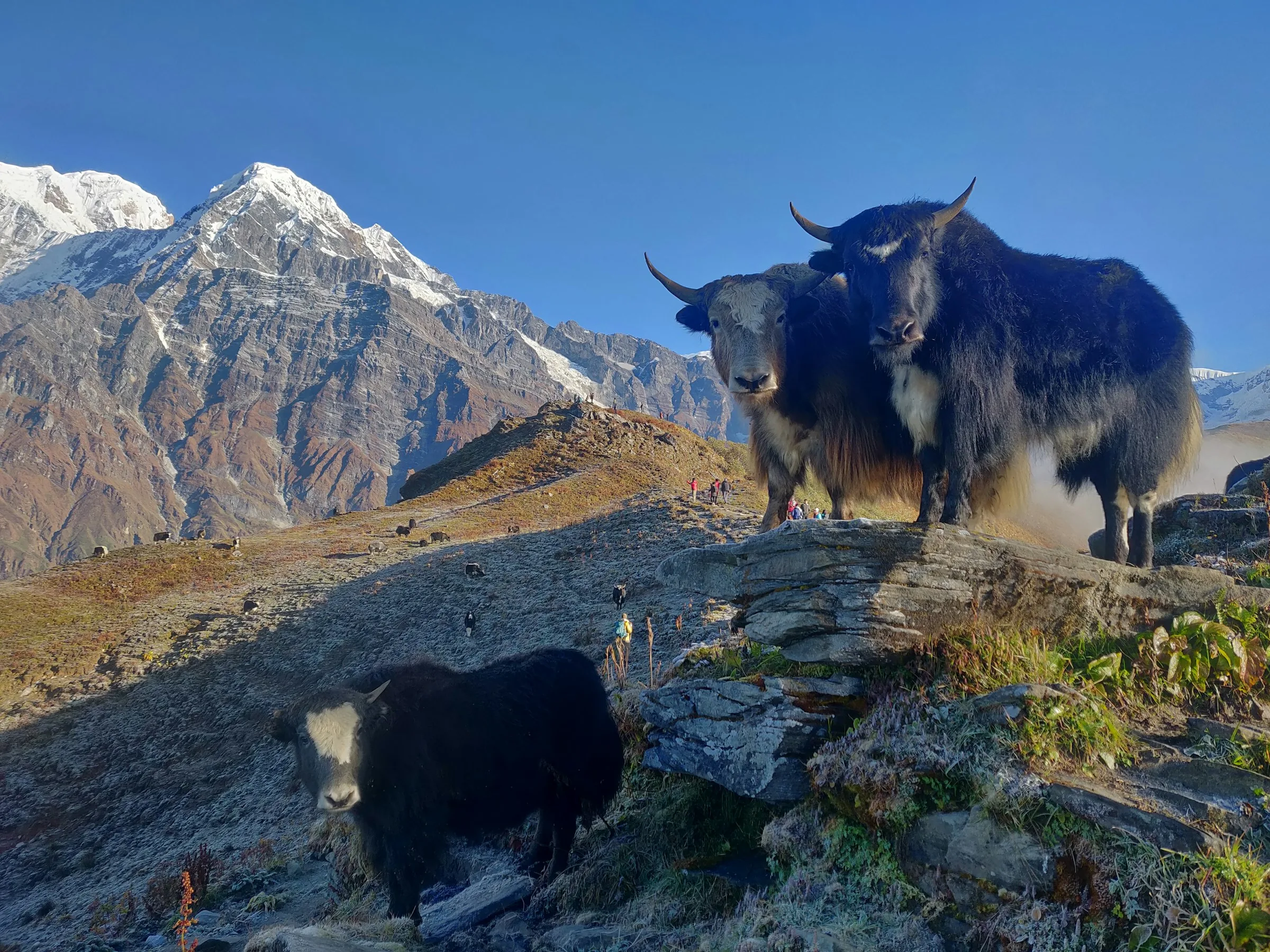
Mardi Himal independent trek: route, costs and permits
Mardi Himal is the quieter, more dramatic cousin of Annapurna Base Camp. Same conservation area, same permit, half the foot traffic, and a final ridge walk that sits you about four-and-a-half kilometres up with Machhapuchhre filling most of the sky. Four to six days from Pokhara, doable solo, no guide required.
Why this trek?
Mardi Himal is the trek you choose when you have looked at ABC and the Circuit and want something between the two. The pitch:
- It is genuinely less crowded — the trail opened to teahouse trekking only in the early 2010s, and the lodges are smaller and fewer.
- The whole second half is a ridge walk, which means open views in every direction rather than the narrow valley corridor that defines ABC.
- Machhapuchhre — the unclimbed Fishtail peak — is right there. From High Camp upwards it is the single most prominent thing in your field of vision.
- It tops out higher than ABC (4,500 m vs 4,130 m), which is a real consideration for altitude planning, but the ascent profile is gentler.
- One permit. ACAP. That is the entire bureaucracy.
The trade-off versus ABC: fewer lodges, slightly higher prices, and on the busiest weeks of the year you may find yourself walking further than planned because High Camp filled up. Versus Poon Hill: more days, more altitude, more commitment.
The route, day by day
Standard 5-day itinerary. You can compress to 4 if you skip the Forest Camp warm-up day, but the gentler ascent helps with altitude — and adds an evening in the rhododendron forest, which is a fair trade.
| Day | From → To | Altitude | Time |
|---|---|---|---|
| Day 1 | Pokhara → Kande → Australian Camp → Forest Camp | 2,550 m | 5–6 h walk |
| Day 2 | Forest Camp → Low Camp | 2,970 m | 3–4 h walk |
| Day 3 | Low Camp → High Camp | 3,580 m | 4–5 h walk |
| Day 4 | High Camp → Upper Viewpoint / Base Camp → Low Camp | 4,200–4,500 m | 7–8 h round trip |
| Day 5 | Low Camp → Sidhing or Pothana → Pokhara | — | 4–5 h walk |
Day 1 — Pokhara to Forest Camp
A short taxi or local bus from Pokhara to Kande (around 1,700 m). The trail climbs steadily up to Australian Camp, which is also a viable lunch stop, then drops slightly and traces a contour through Pothana before climbing into the rhododendron forest. By late afternoon you are at Forest Camp (sometimes signed as Kokhar) at 2,550 m, deep in the trees.
Birethanti is on a different route — the ACAP checkpoint for Mardi is at Pothana. Have your permit ready as you pass through.
Day 2 — Forest Camp to Low Camp
A short, friendly day. Three to four hours through more rhododendron and oak forest, a gentle gradient, no real difficulty. Low Camp at 2,970 m is on the edge of where the trees start to thin out. Spend the afternoon adjusting; the altitude is starting to be real.
Day 3 — Low Camp to High Camp
The day the views open up. The trail breaks out of the forest onto the ridge proper. Machhapuchhre starts dominating the view to the north; Annapurna South and Hiunchuli appear on the left. This is also where you start to feel the altitude. The walk to High Camp at 3,580 m is not technically hard, but you will be slow if you are not acclimatised. Aim to arrive by early afternoon to give yourself time to drink water and rest before the 5 a.m. start tomorrow.
Day 4 — Upper Viewpoint and Base Camp
Summit day. Up at four-something, headtorch on, layers up, out by five. The trail follows the ridge — narrow in places, never technical, but real exposure at first light. By sunrise you are at or near the Upper Viewpoint at around 4,200 m, with Machhapuchhre lit up directly in front of you and the Annapurna massif spread to the west.
From Upper Viewpoint, Mardi Himal Base Camp at 4,500 m is another 1.5–2 hours each way over scrambly, occasionally snow-patched terrain. It is worth doing if your altitude is cooperating; plenty of trekkers stop at the Upper Viewpoint and head back, and they have not missed much.
Back to High Camp for breakfast, then descend to Low Camp for the night. The descent eats your knees more than the ascent.
Day 5 — Out via Sidhing or Pothana
Two ways down. The classic option is to retrace the route through Forest Camp and out to Pothana / Kande. The popular alternative is to drop down via the Sidhing trail — a steeper, more direct descent to a small village with jeep access back to Pokhara. Either gets you back the same evening. Sidhing is shorter on the legs but rougher underfoot.
The solo advantage
Worth the same call-out as on the other Annapurna treks: trekking on your own here means the schedule is yours. If High Camp is full you can drop back to Low Camp without an argument; if your altitude is iffy you can take a rest day; if you want a third night on the ridge to be sure of your weather window, you take one. A guided group is locked to the itinerary they paid for. You are not.
What it actually costs
| ACAP permit (this site) | ~$43 | Permit + $20 service fee |
| Pokhara → Kande taxi | ~$15 | Or local bus for $3–4 |
| Lodge per night | $4–8 | A bit pricier than ABC. Smaller lodges, more remote. |
| Food per day | $15–25 | Dal bhat is your friend up here too |
| Hot shower | $2–5 | Gas at the higher camps; cold lower down |
| Charging / wifi | $2–4 | Most lodges have one or both |
| Total for 5 days | $220–360 | All-in including permit |
Lodge prices on Mardi run a touch higher than ABC because everything has to be portered up to smaller lodges. Worth knowing if you are budgeting tight.
When to go
Same two windows that work everywhere else in this region. October–November for clear post-monsoon skies and reliable weather. March–April for spring, rhododendrons, and longer daylight hours up on the ridge. December–February is doable if you are equipped for cold and don't mind possible snow at High Camp; May–September is monsoon and the views are mostly cloud.
Mardi specifically punishes bad weather more than ABC because the whole second half is exposed ridgeline. A clear window matters more here than on a valley trek.
Gear that actually matters
Same kit list as ABC plus or minus a few details. Pokhara has plenty of shops selling honest-priced replicas; you do not need to fly with everything. The non-negotiables:
- Trekking shoes (broken in!)
- Down jacket — proper one for High Camp and above
- Sleeping bag (-10°C)
- Trekking poles — the descent will thank you
- Headtorch + spare batteries
- Water purification (tablets, filter, or SteriPen)
- Sunglasses + sunscreen
- Buff / neck gaiter
- Light gloves + warm gloves
- Power bank (10,000 mAh+)
- Cash in NPR — no ATMs on the route
Things worth knowing on the trail
Lodges fill up faster than ABC
Mardi has fewer lodges and they are smaller. In peak season (October–November, March–April) the limited beds at High Camp fill by mid-afternoon. Start the day early; if you have a Nepali SIM, lodges further up are usually willing to take a phone reservation.
Start the summit day early
Cloud tends to roll up the ridge from late morning onwards. Most people leave High Camp by 5 a.m. for Upper Viewpoint and Base Camp — you want to be on the ridge before the views close in. Headtorch on, layers up, slow steady pace.
Upper Viewpoint vs Base Camp
Two natural turn-around points beyond High Camp. Upper Viewpoint at ~4,200 m is the classic spot — a narrow ridge with Machhapuchhre filling half the sky. Mardi Himal Base Camp at ~4,500 m is a further 1.5–2 hours each way over scrambly terrain. Plenty of trekkers stop at Upper Viewpoint and head back; nothing wrong with that.
The descent route is a choice
You can go back the way you came (Forest Camp → Pothana → Kande). The popular alternative is to descend via Sidhing — a steep, knee-battering trail down to a small village with road access and a jeep ride out to Pokhara. Either works. Sidhing is shorter on the legs but rougher underfoot.
Solo means your schedule is yours
One genuine perk of trekking on your own: if a lodge is full, you can backtrack or push on without negotiating with anyone. If your legs are wrecked, you take a rest day. If you want to acclimatise an extra night at Low or High Camp, you do. Organised groups are locked to their itinerary; you are not.
Should you do it?
If you are picking between Mardi and ABC, the question is foot traffic vs lodge density. ABC has both more people and more lodges; Mardi has fewer of each. Both are doable solo and both reward it. If you are picking between Mardi and Poon Hill, Mardi is the bigger commitment — more days, more altitude, more chance the weather is the boss of you — but the views from the ridge are on a different scale.
For a moderately fit, independent-minded trekker who has done at least one multi-day walk before, Mardi is one of the best reward-per-difficulty propositions in Nepal. One permit, a week away from your inbox, and a long ridge with the most photogenic peak in the country at the end of it.
Get the permit
Ready to do it?
Sort your ACAP permit in 3 minutes. Delivered within 24 hours.
Get my ACAP permit · $44.28