Poon Hill / Ghorepani independent trek: the honest beginner guide
The Poon Hill / Ghorepani loop is the classic short Himalayan trek — 3 to 5 days, well inside the Annapurna Conservation Area, doable solo, and the most reliable first big mountain experience you can pick in Nepal. Marked trail. Lodges every couple of hours. One permit. No guide required.
Why this trek?
If it is your first time in the Himalayas, this is the one. Reasons:
- It is short — 4 days from Pokhara hotel to Pokhara hotel is achievable.
- Altitude tops out at around 3,200 m, which is far below the danger zone.
- The trail is wide, signed, and busy enough that you will never feel lost.
- Lodges are everywhere — you can stop early if your legs say so.
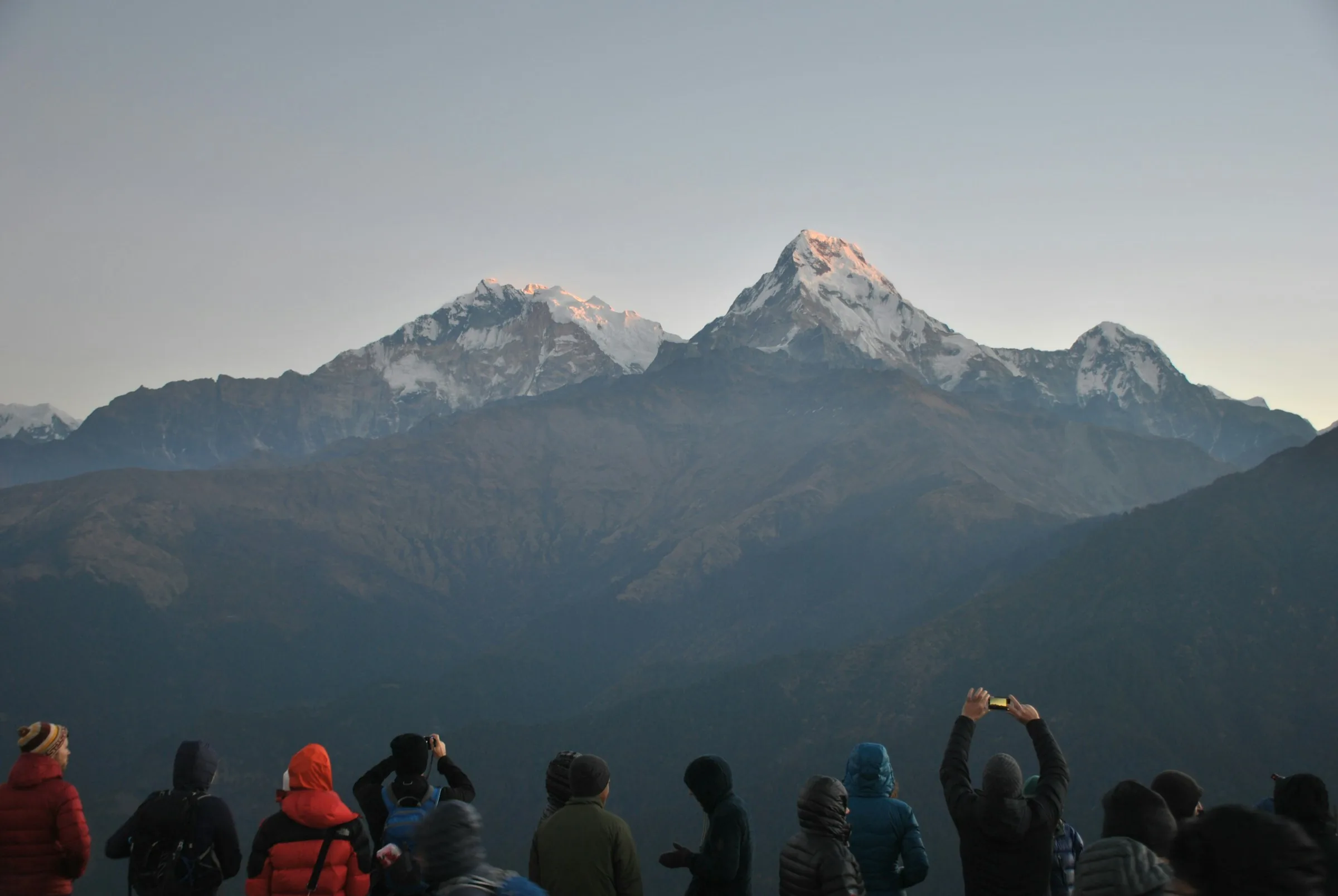
- You get a proper Himalayan view from Poon Hill: Dhaulagiri, Annapurna South, Hiunchuli, Machhapuchhre, all of them.
- It is the cheapest "real" trek in Nepal. Four days, all-in, can be done for around $150.
It is also the trek where almost everyone realises they are absolutely fine to do this without a guide. After your first day on the trail you stop checking the map every five minutes — there is one path and a hundred other trekkers walking on it.
The route, day by day
The standard loop. You can flip it (start from Ghandruk and end at Birethanti) but the direction below is more forgiving for the legs — Ulleri uphill on Day 1 instead of an equivalent descent on the last day.
| Day | From → To | Altitude | Time |
|---|---|---|---|
| Day 1 | Pokhara → Nayapul → Birethanti → Ulleri | 1,960 m | 5–6 h walk |
| Day 2 | Ulleri → Ghorepani | 2,860 m | 4–5 h walk |
| Day 3 | Ghorepani → Poon Hill (pre-dawn) → Tadopani | 2,630 m | 5–6 h walk |
| Day 4 | Tadopani → Ghandruk → Nayapul → Pokhara | 1,025 m | 5–6 h walk |
Day 1 — Pokhara to Ulleri (the stairs)
Taxi or local bus from Pokhara to Nayapul. From Nayapul you walk a short, flat section to Birethanti, where the ACAP checkpoint is. They check the permit, log your details, wave you through.
From Birethanti you have a gentle uphill warm-up to Tikhedhunga. Then the famous bit: the stone stairs to Ulleri. Well over three thousand of them, almost all of it up. It is the toughest single section of the whole trek, and you do it on day one before altitude has had a chance to mess with you. Take rest breaks, slow steady pace, drink water — anyone in reasonable shape will get up them fine.
Day 2 — Ulleri to Ghorepani
A more reasonable day. The trail climbs through rhododendron forest — properly stunning in March and April when the trees are in bloom — and over a couple of small passes into Ghorepani. You walk in through the village gate and the checkpoint sits just after it; have your permit ready and they will note you in.
Ghorepani sits in a saddle at 2,860 m. Find a lodge, drop your bag, and head to the bakery at Fishtail Lodge — fresh bread, decent coffee, and a fairly committed gathering of trekkers most evenings. Worth doing once. Dinner at your lodge afterwards is the usual move.
Day 3 — The Poon Hill morning, then on to Tadopani
Set an alarm for around 4:00 a.m. Layer up — it is cold up there before sunrise. Strap on the headtorch and join the slow line of bobbing lights making its way up the switchbacks. The climb takes about an hour for most people, longer if you stop a lot, and you want to be at the top before the eastern sky starts changing.
At 3,210 m the summit is broad, open, and crowded. You will not be alone. On a clear morning you get the full panorama of Dhaulagiri, the Annapurnas, Machhapuchhre, all of it lit from the side and turning gold. On a cloudy morning you get a thermos of bad coffee, the company of forty other shivering trekkers, and a small lesson in expectation management. Most days are clear in season.
Back to Ghorepani for breakfast, pack up, and walk on. The trail to Tadopani is mostly downhill through more rhododendron forest. Quieter than the Ghorepani end of the route — most groups have peeled off back to Pokhara by now.
Day 4 — Tadopani to Ghandruk to Pokhara
Steady descent through forest, then villages. Ghandruk is a Gurung village with proper stone houses and views back up to Annapurna South — worth a coffee stop at minimum, and worth a night if you have time. From Ghandruk it is a downhill walk to Nayapul and a taxi back to Pokhara.
The solo advantage
Worth saying directly: trekking on your own here gives you something an organised group does not get, which is a flexible schedule. If you finish a day strong and want to push on to the next village, you can. If your legs are toast and you fancy a rest day in Ghorepani sitting in the bakery reading a book, you can. If you find a lodge with a view you want to spend an extra night at, nobody is pulling you out the door.
A guided trek is locked to its itinerary. You are not. That is genuinely one of the nicer parts of doing this independently.
What it actually costs
| ACAP permit (this site) | ~$43 | Permit + $20 service fee |
| Pokhara → Nayapul taxi | ~$15 | Or local bus for $3 |
| Lodge per night | $3–6 | Free or near-free if you eat at the lodge |
| Food per day | $12–20 | Dal bhat, momos, the usual |
| Hot shower | $1–3 | Solar in lower lodges, gas higher up |
| Bakery treats in Ghorepani | $2–5 | You will spend this. Worth it. |
| Total for 4 days | $130–200 | All-in including permit |
When to go
Two windows that work: October–November (post-monsoon, crystal-clear skies, busiest of all on this trek) and March–April (spring, the rhododendrons are why you came). December–February is fine but cold and dark; the Poon Hill morning will hurt. May to September is monsoon — wet, leech-rich, low cloud, not the trip you imagined.
Gear that actually matters
Pokhara has a hundred shops selling honest-priced North Face / Mountain Hardwear knockoffs. You do not need to fly with everything. The non-negotiables:
- Trekking shoes (broken in!)
- Warm jacket — fleece + down for the Poon Hill morning
- Headtorch + spare batteries
- Trekking poles (Ulleri stairs will thank you)
- Water purification (tablets, filter, or SteriPen)
- Sunglasses + sunscreen
- Light gloves
- Power bank — charging is paid in lodges
- Cash in NPR — ATMs are scarce on the route
Things worth knowing on the trail
There is a checkpoint on the way into Ghorepani
On top of the ACAP checkpoint at Birethanti, Ghorepani has a checkpoint as you arrive. Have your permit handy. Same routine as before — they note your details and wave you through.
The Fishtail Lodge bakery in Ghorepani
Worth the small detour. Fresh bread, pastries, decent coffee — small luxuries that hit very differently after a day on the stairs. Most evenings the trekking crowd ends up there.
Start Poon Hill in the dark
The standard plan: leave the lodge around 4:30 a.m. with a headtorch, walk up the steady switchbacks for an hour, get to the top before the eastern sky changes. Most days you get the spectacular sunrise; on a cloudy morning you get camaraderie and bad coffee at the top — also fine.
Solo means your schedule is yours
One real perk of trekking on your own: if you find a lodge or village worth sticking around in, you stay. If your legs are wrecked, you take a rest day. You are not on someone else's clock. Organised groups don't get to do that — they have to keep moving on the agreed itinerary.
Should you do it?
If you are a moderately fit person who is comfortable walking up hills for five hours, yes. If it is your first multi-day trek anywhere, this is a kind one to learn on. The altitude is real but mild. The route is forgiving. The lodges are warm.
What you get: a proper Himalayan sunrise from a 3,200 m viewpoint, a couple of days in rhododendron forest and Gurung villages, and the small but specific satisfaction of working out that you can in fact do this on your own.
Get the permit
Ready to do it?
Sort your ACAP permit in 3 minutes. Delivered within 24 hours.
Get my ACAP permit · $44.28